
The Black Monks
Nothing is true, everything is permitted. Part 1

“We work in the dark to serve the light.” – Assassin’s Creed maxim.
According to the historian Edwin Johnson (1842-1901) the whole system of Christianity originated in the Middle Ages, and its first literature was the product of two great primitive Orders of Greek and Latin monks, who were united in this enterprise.1
“The sojourn [dwelling] of Greeks and Latins under one roof for a long period at the beginning of the activity may be regarded as a certain fact, and one that explains the rise of Church literature.”2
This dwelling, Johnson found in Southern Italy. Perhaps no other region at this time contained such a rich fusion of Latin, Greek, Arab, Jewish and Norman influences.
Before falling under Roman rule around 282 BC, Southern Italy was known as Magna Graecia, meaning “Great Greece” in Latin. This Greek-speaking area encompassed the modern Italian regions of Calabria, Apulia (Puglia), Basilicata, Campania, and Sicily.
Even after Roman subjugation, Greek culture and language persisted, especially during the East Roman (Byzantine) period. This continued until as late as the Norman conquests in the 11th century, which finally ended direct imperial rule.
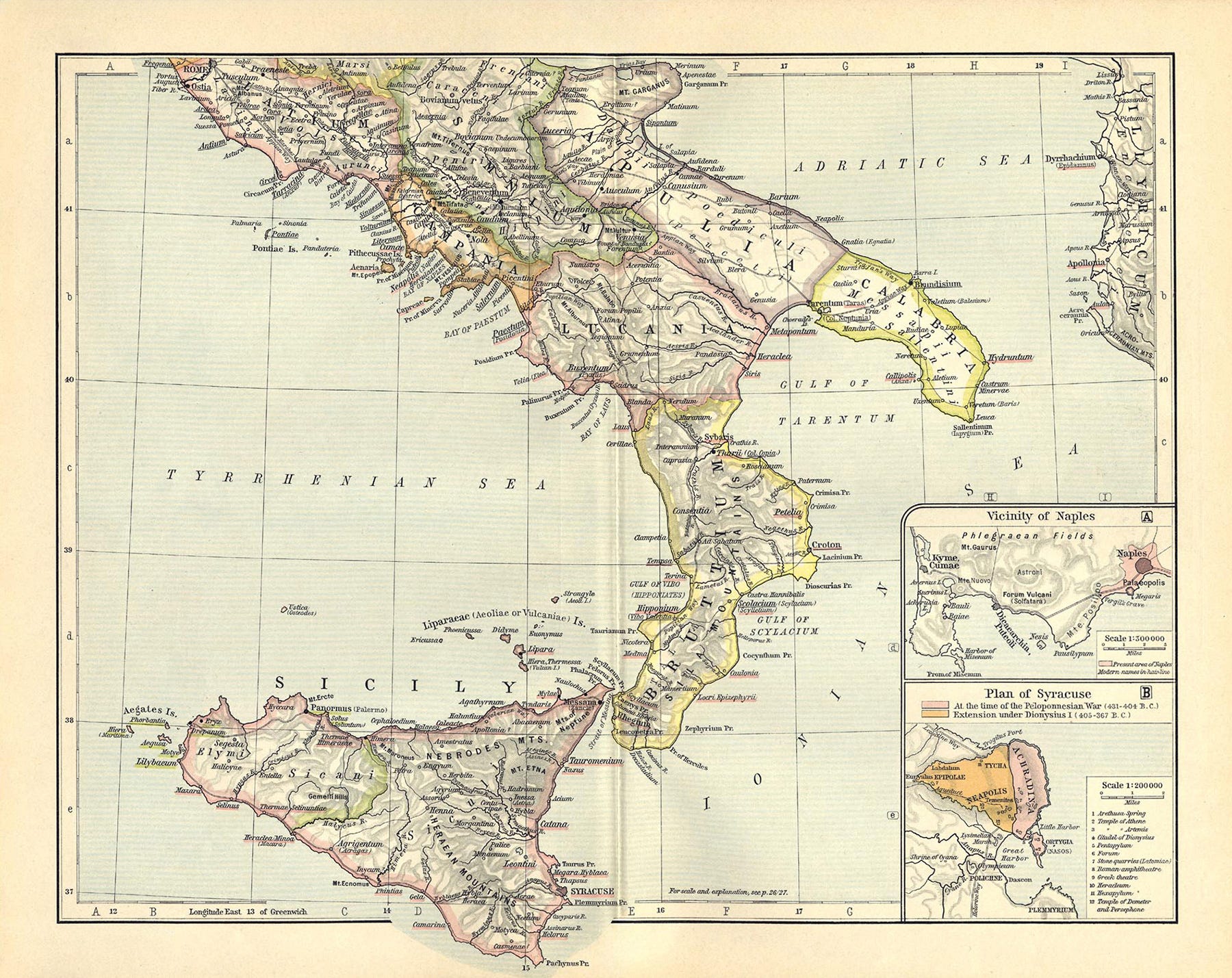
Italia, Bruttium, Calabria.
“In ancient times the lands of present-day Calabria were known as Italy.”3
The ancient Greeks who settled in this land starting from the 8th century BC used the term Italoi to indicate the native population.4 The Greeks established the first cities, mainly on the coast, and during this period Calabria was the heart of Magna Graecia.
The name Calabria was originally given to the Adriatic coast of the Salento peninsula in modern Apulia. At this time modern Calabria was known as Bruttium, after the Bruttians, an ancient Italic people who inhabited the region. Later in the 7th century AD, the Byzantine Empire used the name Calabria for the territory of Bruttium.
Edwin Johnson makes special note of Southern Italy in his works, suggesting this region was the original Holy Land, and not the area encompassing modern-day Israel and Palestine.
“But perhaps her true Holy Land is Apulia, Calabria, and Sicily. Surely no student can thoughtfully traverse those regions, observing the remains of the old Greek and Roman, of Byzantine, of Arab, of Norman culture, without feeling that he is on ground far more interesting to our Western humanity than Cappadocia, Syria, or Egypt. We are there in the centre of our world.”5
The significance of Southern Italy has largely gone unnoticed by most researchers. I believe the importance of this region has been deliberately disregarded in order to conceal the true origins and authors behind the New Testament Gospels.
